Why 2 barand not 3 bar.
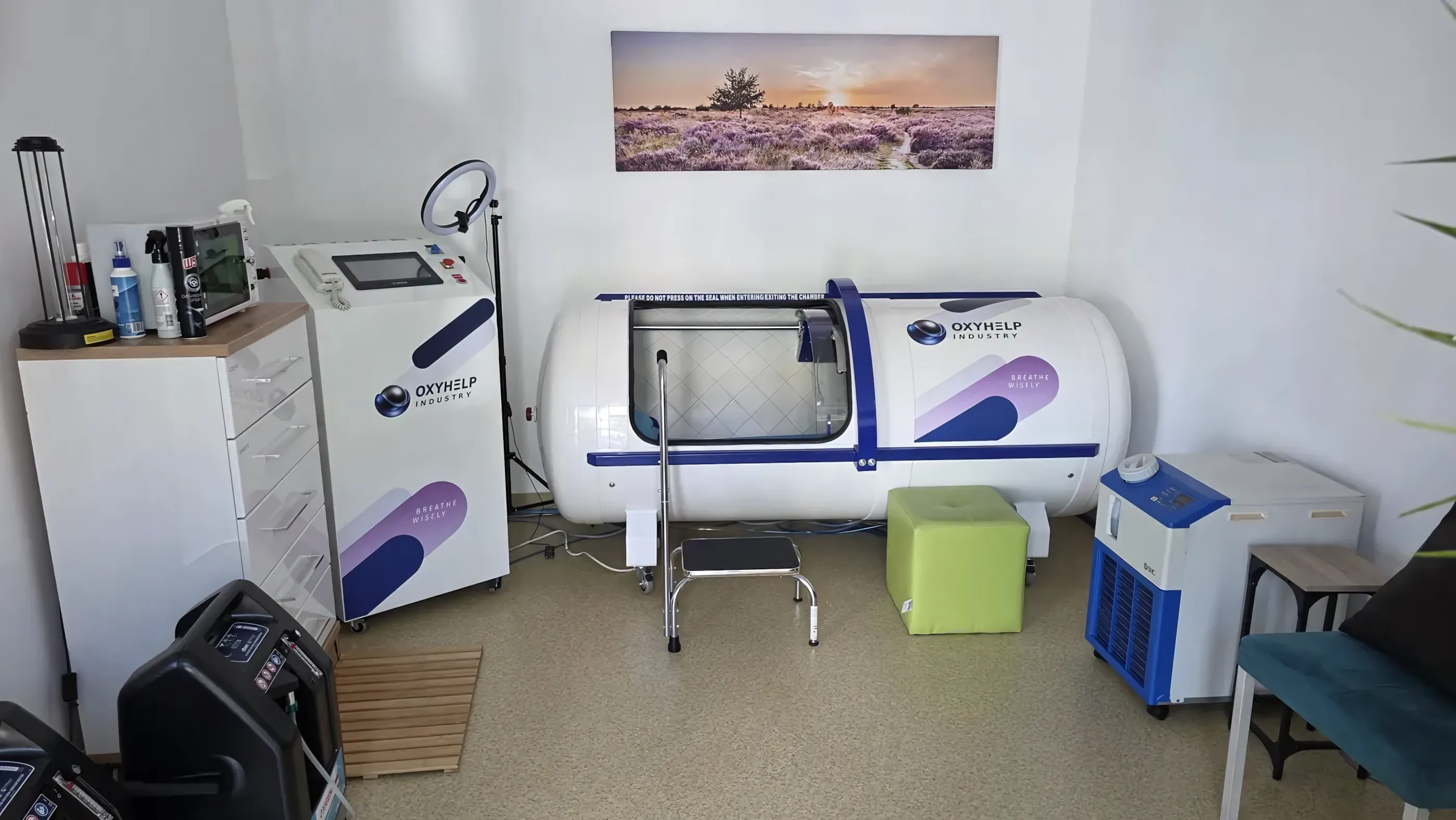
There is a confusion between brute force (high pressures) and the biological result. At CryoMedica we configured the HBOT protocol up to 2.0 bar (2.0 ATA), with oxygen delivered through a mask, for a reason based on physiology, not on marketing. The same pressure used by the elite centres in Israel (Sagol, Shamir) and the USA.
The difference between recovery and emergency.
Pressures between 2.0 and 3.0 bar belong to diving medicine: they are used to crush nitrogen bubbles in the event of a diving accident. For tissue regeneration, neurological recovery or anti-ageing, studies from Israel and the USA show that 2.0 bar is the point at which the body responds best. There is no need to fill the entire chamber with oxygen to achieve results, and we do not do it.
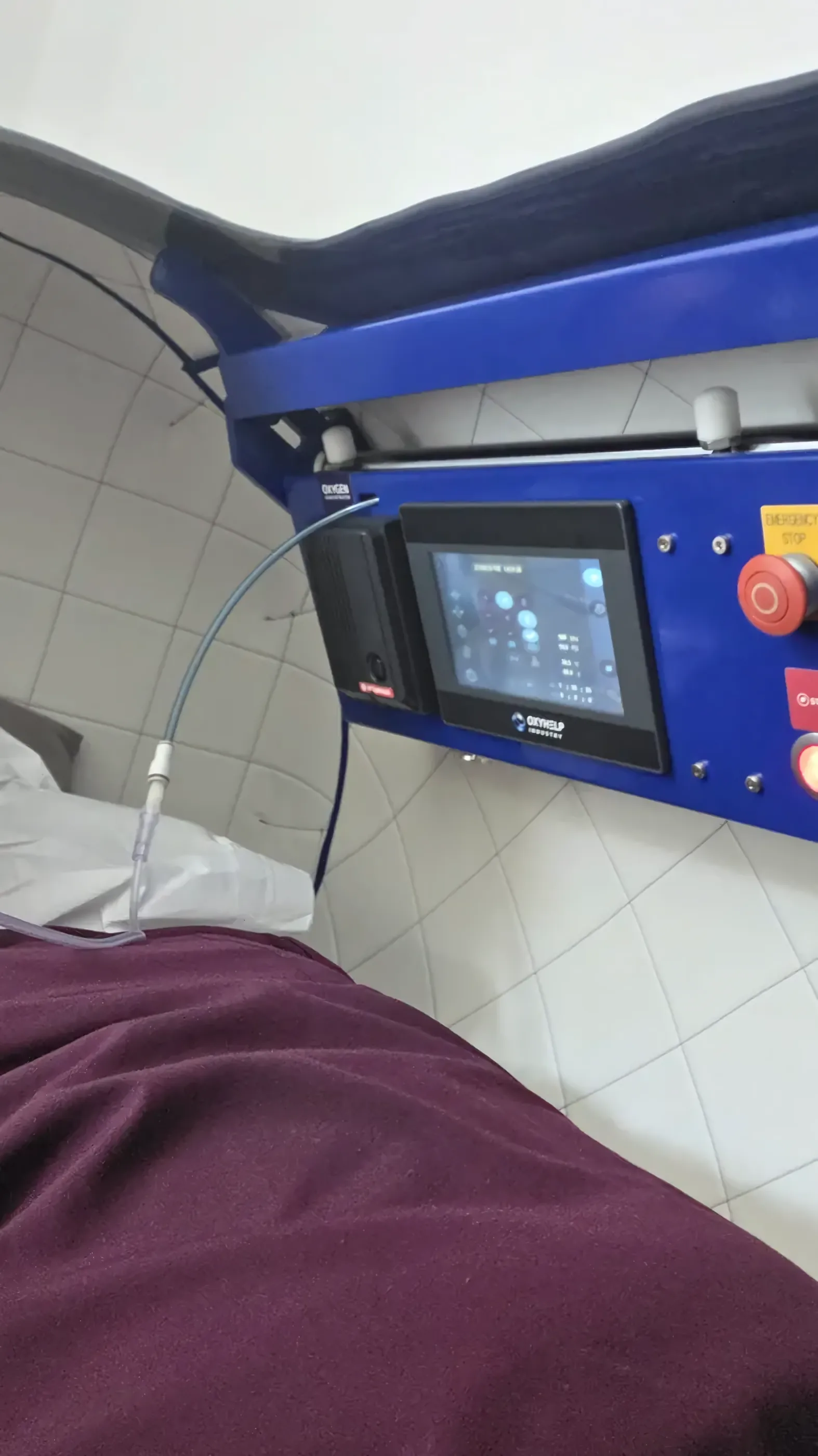
At CryoMedica, the capsule is pressurised with air, and the enriched oxygen (93–96%) is delivered individually, through a mask. This is the method adopted by the major recovery centres because it eliminates the fire risk, does not strain the lungs and the middle ear with unnecessary pressures, and allows long sessions (60–90 min), which are required for the stem cells to activate.
Saturating the plasma with oxygen.
At a pressure of 2 bar, the oxygen you breathe through the mask is forced to dissolve directly into the liquid of the blood (plasma), according to Henry's Law. This carries oxygen to the areas where circulation is blocked or reduced, without needing red blood cells. Concretely: at 2.0 bar you reach roughly 4.2 ml O₂ per 100 ml plasma, enough to oxygenate tissues with poor vascularisation and to "awaken" the dormant metabolic neurons in the penumbra area.
- Oxygen dissolved directly into the plasma, transport independent of haemoglobin
- Covers tissues with reduced vascularisation (chronic wounds, oedema, lesions)
- ~4.2 ml O₂ per 100 ml plasma at 2.0 ATA
- Maximised plasma oxygenation without saturating the chamber with enriched oxygen
The activation threshold of regeneration.
Fundamental research (Thom et al., Journal of Applied Physiology) shows that hyperbaric oxygen acts as a signalling agent. At 2.0 ATA, the partial pressure needed to trigger the mobilisation of CD34+ stem cells 8 times more than at sea level is reached. These are the body's "repair cells", essential for deep tissue regeneration.
At 3.0 ATA, further increasing the pressure does not bring a linear mobilisation of stem cells; instead, it significantly raises the risk of lipid peroxidation, a process that damages cell membranes. That is why the 2 bar protocol allows a larger number of sessions (40–60) to be administered, which is needed for deep regeneration, without depleting the body's antioxidant reserves.
- CD34+ mobilisation ×8 at 2.0 ATA (Thom et al., J. Appl. Physiol.)
- 3.0 ATA = lipid peroxidation, no additional regeneration benefit
- 40–60 session protocol for neurological / bone regeneration
Neuroplasticity at 2.0 ATA.
The most extensive clinical studies of the last decade on brain regeneration (Efrati et al., Sagol Center, Israel) used exclusively the 2.0 ATA protocol. The brain has a high metabolic consumption but a limited capacity to process free radicals. At 2.0 bar, plasma oxygenation is maximised (~4.2 ml O₂ per 100 ml plasma), enough to "awaken" dormant metabolic neurons (ischaemic penumbra), without triggering the neurotoxicity specific to the 3.0 bar threshold.
- Sagol Center (Israel) · Efrati et al.: exclusively 2.0 ATA protocol
- Shamir Clinic (Israel): reference for long-term results
- Support for "dormant" metabolic neurons (penumbra)
- The standard used by top US clinics for regeneration
The Paul Bert Effect and the CNS.
Patient safety is dictated by the physiological limits of the central nervous system. Oxygen toxicity at high pressures (the Paul Bert Effect) is the main reason modern recovery protocols avoid 3.0 ATA. At 2.0 ATA, the toxicity threshold is extremely far off, allowing 60–90 minute sessions safely.
At 3.0 ATA, the risk of hyperoxic seizures rises exponentially. In the USA, the use of this pressure outside a multiplace chamber (where the patient can be assisted immediately from inside) is considered a high-risk practice, unjustified in recovery therapy. At 3.0 bar there is also the risk of severe barotrauma (injury to the eardrum or lungs) and cellular fatigue caused by free radicals.
- 2.0 ATA · extended CNS safety window · 60–90 min sessions
- 3.0 ATA · exponential risk of hyperoxic seizures
- 3.0 ATA · eardrum / lung barotrauma · cellular fatigue
- In the USA · 3.0 ATA reserved almost exclusively for emergencies (decompression)
Vasoconstriction and blood flow.
Too high a flow of oxygen (at 3.0 bar) causes a severe reactive vasoconstriction. The body, trying to protect tissues from a massive influx of free radicals, closes the capillaries. Paradoxically, the additional oxygen no longer reaches the centre of the lesion you wanted to treat efficiently.
- 2.0 ATA · moderate vasoconstriction, reduces oedema, preserves optimal capillary perfusion
- 3.0 ATA · severe vasoconstriction, closes capillaries, blocks oxygen delivery to the lesion
- Air breaks (the "Hyperoxic-Hypoxic Paradox") stimulate growth factors
- A mechanism perfected in the top clinics in Israel
Dual AirSep concentrators · 93–96% purity.
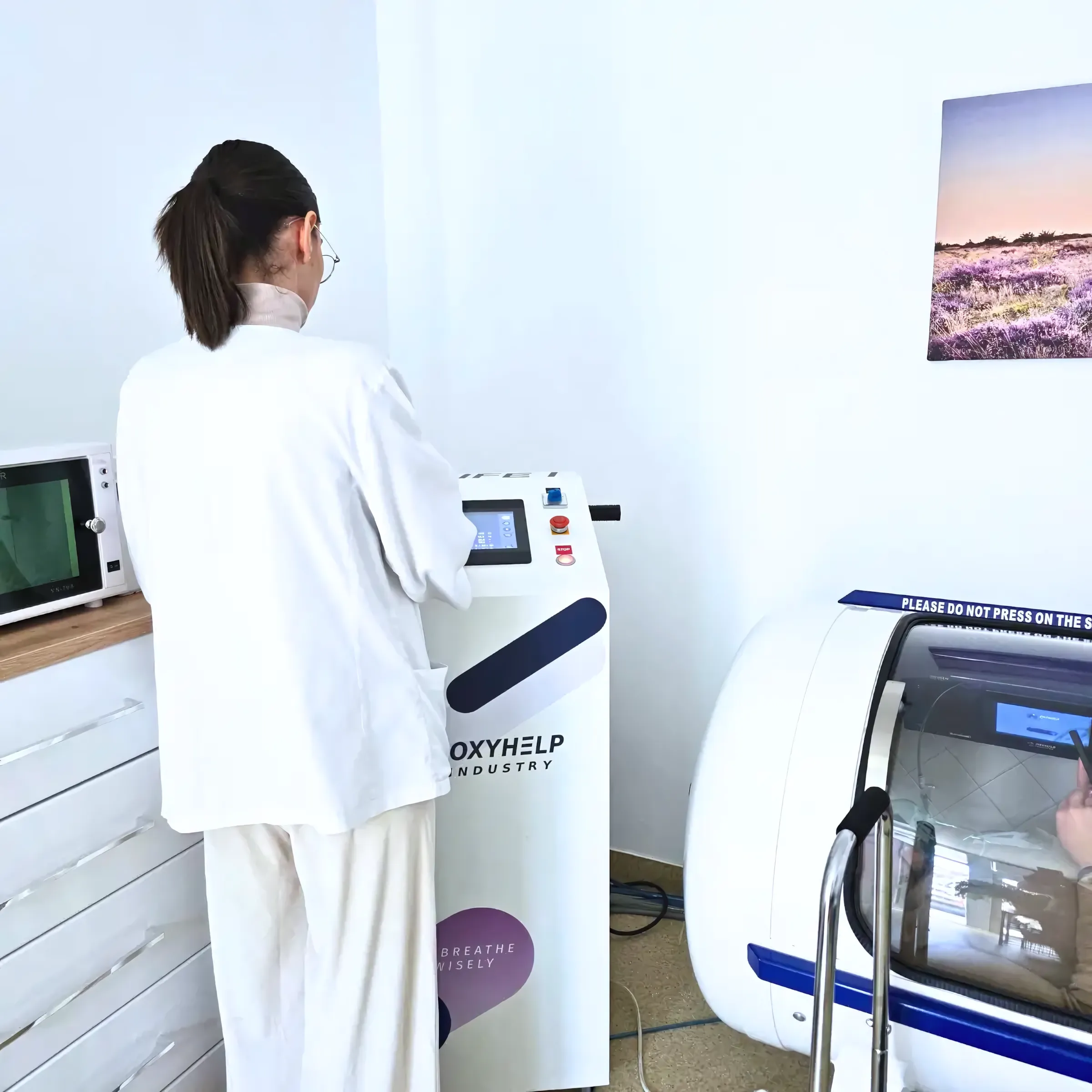
We use the Oxyhelp® monoplace capsule + two AirSep Intensity medical concentrators. The maximum capacity is 10 l/min per unit, but we run them at 7 l/min for a total flow of 14 l/min, double the average respiratory need of an adult (~7 l/min). This keeps the purity of the delivered oxygen stable between 93% and 96% throughout the session.
Sources that claim "100%" oxygen are not technically accurate for on-site concentrators: any molecular sieve concentrator produces an oxygen-enriched mixture, never fully isolated molecular oxygen. We are transparent on this point: the real purity is 93–96%, enough to saturate the plasma according to Henry's Law at 2 bar.
- Oxyhelp® monoplace capsule · air pressurisation + individual mask
- 2× AirSep Intensity concentrators · 7 l/min each · total flow 14 l/min
- Stable O₂ purity 93–96% (on-site medical concentrators)
- Active UV sterilisation (Israel/USA import standard)
- Silver nano-ion filters · antibacterial / antiviral action
- Concentrators replaced preventively at 15,000 hours (vs. 20,000–30,000 hours warranty)
- Filters replaced monthly (vs. the 3-month standard)
2.0 bar · a safety standard, not a limitation.
Using the 2.0 bar threshold with a concentrator is not a technical limitation, but a safety standard. It is the threshold that delivers the best long-term results while protecting the integrity of the central nervous system and of delicate tissues. The same pressure used by the Sagol and Shamir centres (Israel) and by elite US protocols for regeneration, neuroplasticity and anti-ageing.
For the full list of conditions where HBOT is used as a complementary method, see the Conditions page. For the 5–40 hour packs and validity, see the wellness pricing.
Start with an individual evaluation.
Find us at Calea Turzii 137A, right by the Sigma roundabout in Cluj-Napoca. Bookings by phone or WhatsApp; the initial evaluation is free and shapes the right plan for your goal.